Testing & Optimization
How to Backtest Telegram Trading Signals Before Copying Them to a Real Account
Screenshots and win-rate claims prove nothing. Here is how to evaluate a Telegram signal provider on historical data — the metrics that matter, the traps that inflate results, and why history never guarantees the future.
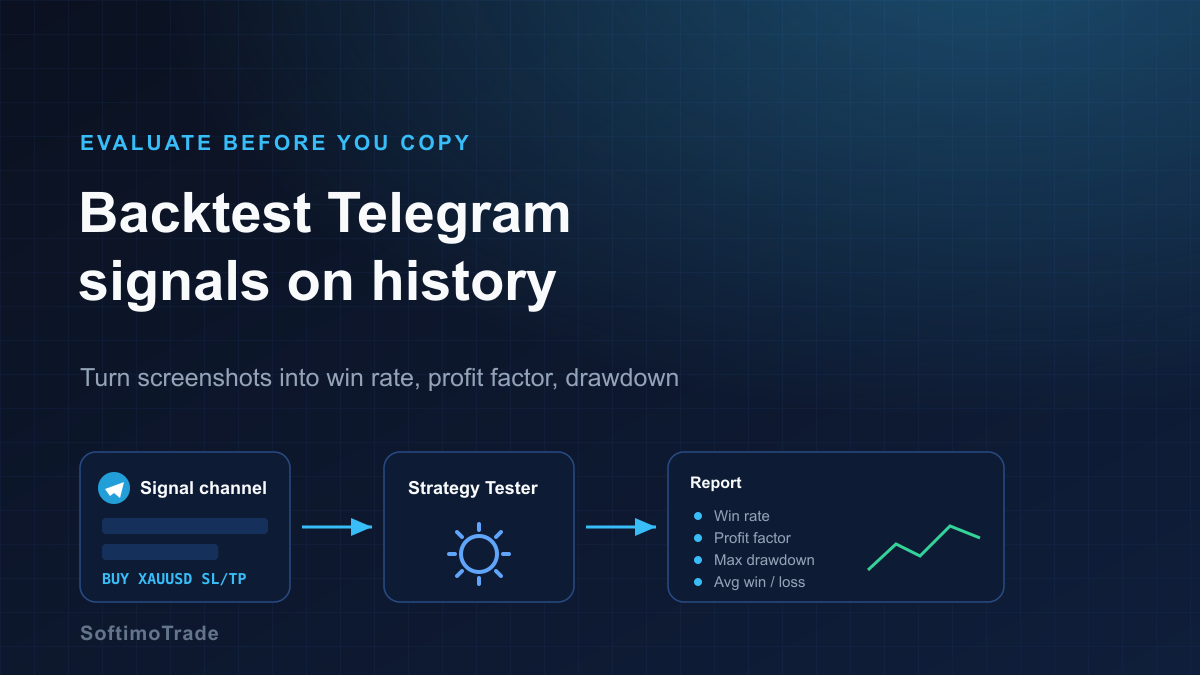
Before you connect a Telegram channel to a live account, there is one question worth answering with numbers rather than trust: if I had followed this channel mechanically, what would have happened? A backtest of the channel's own historical signals turns a wall of screenshots into a few honest statistics.
Short answer: To backtest a Telegram signal provider, collect its historical messages, convert each into a structured trade (direction, entry, stop loss, take-profit), then replay those trades over historical price data using your broker's realistic spread and commission. The output is a set of metrics — win rate, average win/loss, profit factor and maximum drawdown — over a known number of trades. This shows how the signals would have behaved. It does not predict the future, and results are only as trustworthy as the completeness of the signal history.
Why screenshots and win-rate claims are not evidence
A channel that posts "+800 pips this week" is showing you the winners. What you cannot see from a feed of screenshots is:
- how many trades lost, and by how much;
- the drawdown you would have sat through to reach that profit;
- whether the winning trades were realistically fillable at your spread;
- how large the sample is (ten lucky trades prove nothing).
A single number without its context is marketing. A backtest supplies the context.
Step 1 — Collect the historical signals
Export the channel's message history and reduce each tradable post to a row of data:
| Field | Why it matters | | --- | --- | | Timestamp | Fixes the entry moment against historical price | | Direction | BUY / SELL | | Symbol | Mapped to your broker's symbol (GOLD → XAUUSD) | | Entry | Market or a specific level | | Stop loss | Needed to measure risk per trade | | Take-profit(s) | One or several targets |
The completeness of this collection decides everything. If you silently drop the messy or losing posts, you are back to a screenshot.
Step 2 — Replay the trades honestly
With the signal list built, each trade is simulated on historical data. "Honestly" means including the frictions a real account pays:
- Spread — the winner that just clips TP on a mid-price chart may miss it once the real spread is added, especially on gold and indices.
- Commission — per-lot commission on ECN/raw accounts turns marginal winners into losers.
- Multiple targets — split the position across TP1/TP2/TP3 as you actually would, not as a single all-or-nothing exit.
- Break-even / management — if the channel says "move SL to entry after TP1", model it; it changes both win rate and average loss.
Step 3 — Read the metrics that matter
The point of the test is a small, honest scorecard. Each metric answers a different question — and each has a limit.
| Metric | What it tells you | Limitation | | --- | --- | --- | | Win rate | Share of trades that closed positive | High win rate can still lose money if losses are large | | Average win / average loss | Typical size of a winner vs a loser | Averages hide outliers | | Profit factor | Gross profit ÷ gross loss (>1 = net positive) | Sensitive to one or two huge trades | | Maximum drawdown | Worst peak-to-valley equity fall | The next drawdown can be deeper | | Number of trades | Sample size behind every stat above | Small samples are mostly luck |
A useful way to read them together: win rate and payoff are a pair. A 40% win rate is fine if winners are twice the size of losers; an 80% win rate is dangerous if the occasional loss is five times a typical win. Profit factor summarises the pair, and drawdown tells you whether you could actually have held on.
The traps that quietly inflate results
- Survivorship / cherry-picking. Deleted or edited losing signals never make it into the sample, flattering the record. Use the complete message history, including edits and deletions where visible.
- Duplicate signals. Counting a reposted reminder twice double-counts a winner (or a loser).
- Ambiguous entries. "Buy around 2350" backtested at the perfect price is optimistic; model a realistic fill.
- No spread/commission. The most common way a losing channel looks profitable.
- Ignoring timing. A signal you could only have acted on minutes later is not the same trade.
- Tiny samples. Twenty trades cannot separate skill from luck; look for a meaningful count across different market conditions.
What a backtest can and cannot tell you
A clean backtest answers: "Under my broker's costs, over this history, these signals produced this profit factor and this drawdown, across this many trades." That is genuinely useful — it is the difference between an informed decision and a hopeful one.
It cannot tell you the channel will keep performing. Markets change, the author may change strategy or stop posting, and historical results do not guarantee future results. Trading carries risk, and a good past record is a reason to test further on a demo account, not a reason to size up.
A sensible evaluation workflow
- Collect the full, un-filtered signal history.
- Map the channel's symbols to your broker's symbols.
- Replay with realistic spread and commission, modelling multi-TP and break-even.
- Read win rate, payoff, profit factor, drawdown — always alongside the trade count.
- Demo-test the live feed for a while to confirm the channel still behaves like its history.
- Scale slowly, with your own risk-per-trade limit, never the channel's.
Backtester for Telegram Signals
Check a Telegram signal provider on history before you trust it with real money.
Once a channel has earned trust through numbers, automating the execution is the easy part — see How to Copy Telegram Signals to MT4 and MT5. The order of operations is what protects your account: measure first, automate second.
Sources and further reading
- MetaTrader 5 Strategy Tester Help: metatrader5.com/en/terminal/help/algotrading/testing
- MQL5 Documentation: mql5.com/en/docs
Related articles
Related products
Backtester for Telegram Signals
Check a Telegram signal provider on history before you trust it with real money.
Telegram to MetaTrader Copier
Turn Telegram signals into MetaTrader orders automatically — no manual entry, no DLLs.