Testing & Optimization
How to Backtest a Gold EA in MT5 Properly
Gold is fast, spread-sensitive and news-driven, so a naive backtest flatters it badly. Here is how to test an XAUUSD Expert Advisor realistically — real ticks, correct costs, out-of-sample and forward testing.
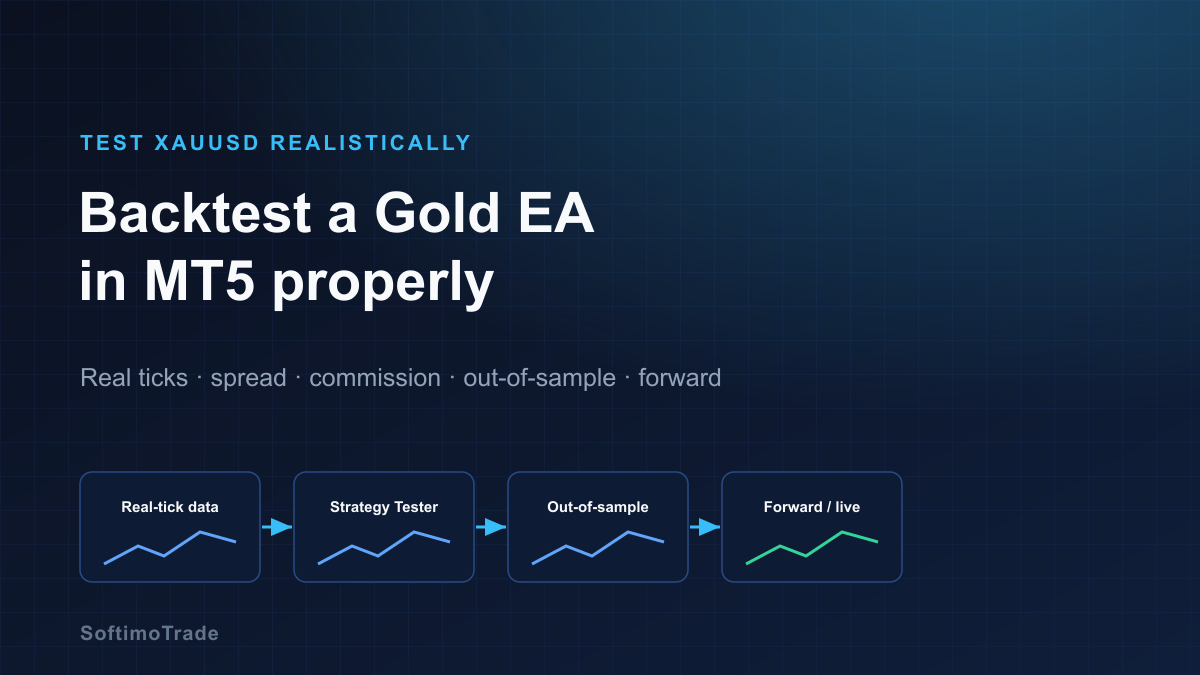
Gold (XAUUSD) is one of the most tempting instruments to automate and one of the easiest to fool yourself on. It moves fast, its spread widens sharply around news, and a backtest that ignores those frictions can turn a mediocre strategy into a beautiful equity curve. Testing a gold EA properly is mostly about removing the illusions one at a time until what remains is trustworthy.
Short answer: To backtest a Gold EA in MT5 properly, use the "Every tick based on real ticks" model with high-quality XAUUSD history, and configure the test with your broker's real spread, commission and contract specifications. Then validate beyond a single in-sample run: test an untouched out-of-sample period, forward-test on a demo feed, and judge drawdown and trade count — not just net profit. A backtest estimates behaviour under past conditions; it cannot promise future results, and live execution will differ.
Start with the tester model and data quality
MT5's Strategy Tester offers several modelling modes. For a spread-sensitive instrument like gold, the choice is not cosmetic:
- Every tick based on real ticks — uses actual historical tick data. This is the model to use for gold; it reproduces the intrabar movement your EA reacts to.
- Every tick (generated) — synthesises ticks from bars; acceptable for rough checks, misleading for scalpers.
- 1 minute OHLC / Open prices — far too coarse for anything touching gold's intrabar behaviour.
Whichever model, the result is only as good as the history behind it. Watch the tester's modelling quality and history completeness — gaps, missing sessions or a short history quietly distort results. Poor data is the most common reason a backtest and live trading disagree.
Get the XAUUSD symbol specification right
Gold is not a currency pair, and its contract details differ by broker. Before trusting any result, confirm the symbol's specs in MT5 (right-click the symbol → Specification):
| Property | Why it matters for gold | | --- | --- | | Digits | XAUUSD is often quoted to 2 decimals; point/pip value depends on it | | Contract size | Defines what one lot is worth — drives P/L and risk | | Tick value / size | Converts price movement into money correctly | | Spread (and floating spread) | Gold's spread widens on news; a fixed test spread understates cost | | Commission | Per-lot on raw/ECN accounts; must be in the test | | Swap | Overnight cost matters if the EA holds positions |
If the tester uses different specs than your live broker, the backtest is testing a different instrument than the one you will trade.
Model the real costs — this is where gold results live or die
- Spread. Testing on a fixed, tight spread is the classic way to make a gold scalper look brilliant. Use your broker's realistic spread, and remember it floats — it can multiply around high-impact news.
- Commission. On raw-spread accounts the cost moves from spread to commission; leaving it out inflates every result.
- Slippage. The Strategy Tester cannot fully reproduce slippage and requotes. Real gold fills, especially at news, can be materially worse than the tester's. Treat backtested entries/exits as optimistic.
- Execution differences. The tester assumes an idealised fill; live latency, broker execution and liquidity gaps all add up against you.
Timeframe, period and market conditions
- Timeframe — test on the timeframe the EA actually trades; results are not transferable across timeframes.
- Testing period — long enough to include different regimes: trending gold, ranging gold, and high-volatility episodes (rate decisions, CPI, geopolitical spikes). A period that is all one regime tells you only about that regime.
- News windows — decide deliberately how the EA behaves around scheduled high-impact news; gold's worst slippage clusters there.
In-sample vs out-of-sample, and forward testing
This is the step most casual tests skip, and it is the one that catches overfitting.
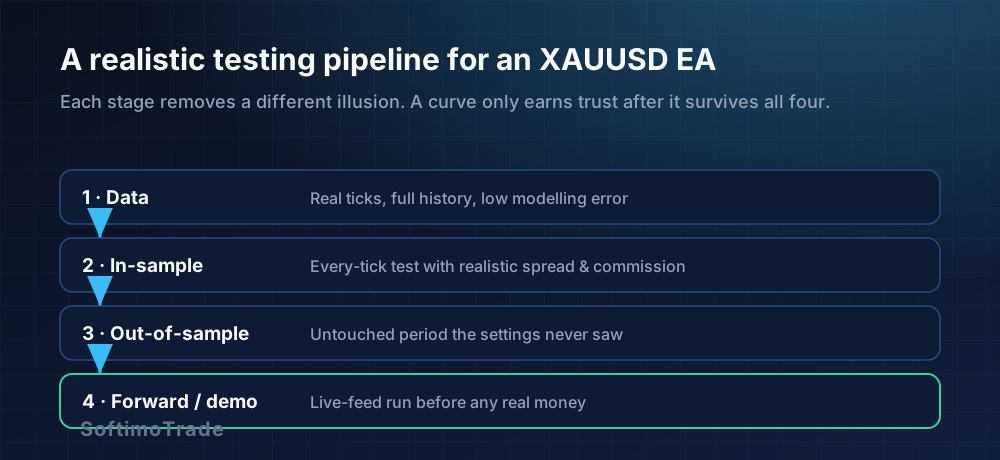
- In-sample — the period you build and optimise on. Great results here are expected, even for a bad strategy, because the settings were tuned to it.
- Out-of-sample — a separate period the optimisation never touched. If performance holds up here, the edge is more likely real than fitted.
- Forward test — run the EA on a live demo feed for a while. This adds real-time spread, real ticks and real latency that no historical test fully captures.
A strategy that shines in-sample but collapses out-of-sample is overfitted: its parameters memorised the past instead of capturing a repeatable behaviour. Gold, with its sharp moves, makes overfitting especially easy — there is always a parameter set that would have caught the big spikes.
Read the right metrics — not just the equity curve
One spectacular equity curve is not evidence. Judge a gold backtest on the whole picture:
| Metric | What it tells you | | --- | --- | | Net profit | The headline — and the most misleading in isolation | | Maximum drawdown | The pain you would have endured; can you actually hold it? | | Profit factor | Gross profit ÷ gross loss (durability of the edge) | | Recovery factor | Profit relative to drawdown | | Number of trades | Sample size — dozens of trades prove little | | Consistency | Is profit spread across the period, or one lucky spike? |
A modest, steady curve over many trades and several market regimes is worth far more than a vertical line built on a handful of fortunate news moves.
Why backtest, forward and live always differ
Even a careful backtest is an estimate. Live results diverge because of:
- slippage and requotes the tester cannot fully model;
- floating spread and commission that vary with conditions;
- broker-specific execution and latency;
- the simple fact that the future is not the past.
Historical and backtested results do not guarantee future performance, and trading gold carries real risk. The goal of proper testing is not certainty — it is to reject the strategies that only ever worked on paper, and to size the survivors conservatively.
Practical checklist
- Use Every tick based on real ticks with complete, high-quality XAUUSD history.
- Verify the symbol specification matches your live broker.
- Include realistic (floating) spread, commission and swap.
- Test on the EA's real timeframe, over a long, multi-regime period.
- Validate out-of-sample, then forward-test on demo.
- Judge drawdown, profit factor and trade count, not just net profit.
- Run live on a VPS — see How to Run a Forex EA on a VPS — and keep monitoring the live vs tested behaviour.
For a deeper walkthrough of the tester's settings and optimisation, see Optimization of Expert Advisors in MT5.
GoldPro
An XAUUSD (gold) expert advisor with two selectable modes — Classic and Scalping.
Testing a gold EA properly is disciplined scepticism: assume every clean result is hiding a cost until you have added the spread, the commission, the out-of-sample period and the forward test. What survives all four is the only thing worth trading — and even then, at a size you can afford to be wrong about.
Sources and further reading
- MetaTrader 5 Strategy Tester Help: metatrader5.com/en/terminal/help/algotrading/testing
- MQL5 Documentation — Testing and symbol properties: mql5.com/en/docs